
RPA Guide Part 1: Understanding Your Role
Last Updated: 9/22
Regional Program Administrators connect statewide program direction with the people and organizations delivering FIRST programs locally.
The RPA maintains the overall picture for their assigned program and region. This includes understanding team needs, coordinating the regional event structure, maintaining relationships with local partners, monitoring progress, and making sure FIRST Texas knows when support or a decision is needed.
This guide introduces the shared expectations of the role. It does not attempt to explain every process or assign every event task to the RPA. More detailed guidance is available throughout the Partner Resources page and will continue to be added as processes develop.
FIRST Texas also works with each RPA through regular calls, regional work plans, and direct support. These conversations allow statewide expectations to be applied to the needs, capacity, and structure of each region.
Table of Contents
Purpose of the role
Understanding RPA Responsibilities
Shared Responsibilities Across Regions
Regional Flexibility
Working with Event Partners
Working with FIRST Texas
What RPAs do not automatically own
Using the RPA Guide Series
The Purpose of the Role
A Regional Program Administrator (RPA) coordinates a FIRST program within a defined region. The role may be held by an individual or an organization. When an organization serves as the RPA, it should identify the person or people responsible for communicating with FIRST Texas and coordinating the work described in this guide. RPAs may receive Program Delivery Partner access to the applicable FIRST systems.
The RPA provides administrative, coordination, and operational support for either FIRST LEGO League or FIRST Tech Challenge within an assigned region.
At the most basic level, the RPA helps ensure that:
The region has an appropriate season structure and enough event opportunities for its teams.
Regional events move from proposed opportunities to confirmed plans.
Major areas of work have identified owners.
Teams, coaches, hosts, volunteers, and FIRST Texas receive the information they need.
Regional risks, gaps, and decisions reach the appropriate FIRST Texas staff member.
Local perspectives inform statewide planning and program improvements.
The RPA owns regional coordination. The RPA does not automatically own every task required to deliver the region or its events.
Understanding RPA Responsibility
The word responsible can describe several different types of involvement. Depending on the region, event, and available partners, an RPA may lead some areas directly and coordinate or support others.
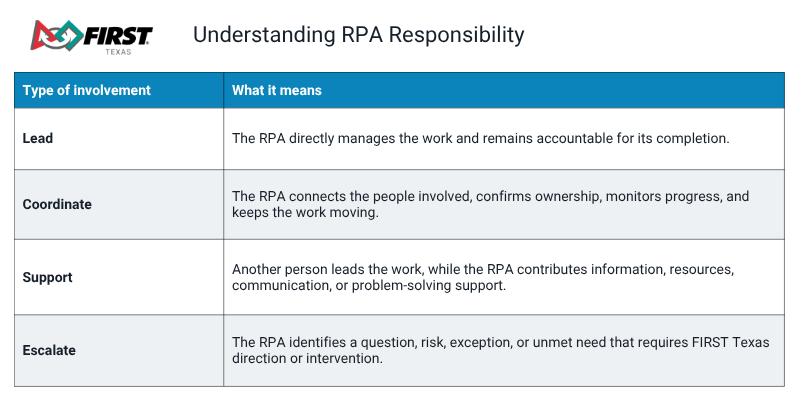
An RPA may also serve as an Event Director, Volunteer Coordinator, or member of a local planning team when that arrangement makes sense. Holding the RPA role does not automatically assign those additional roles.
The division of work should be discussed intentionally and recorded in the regional work plan or applicable event-planning materials.
Shared Responsibilities Across Regions
Each region has a different event structure, geography, partner network, volunteer base, and level of local experience. The way an RPA completes the work will vary, but all RPAs share the following areas of responsibility.
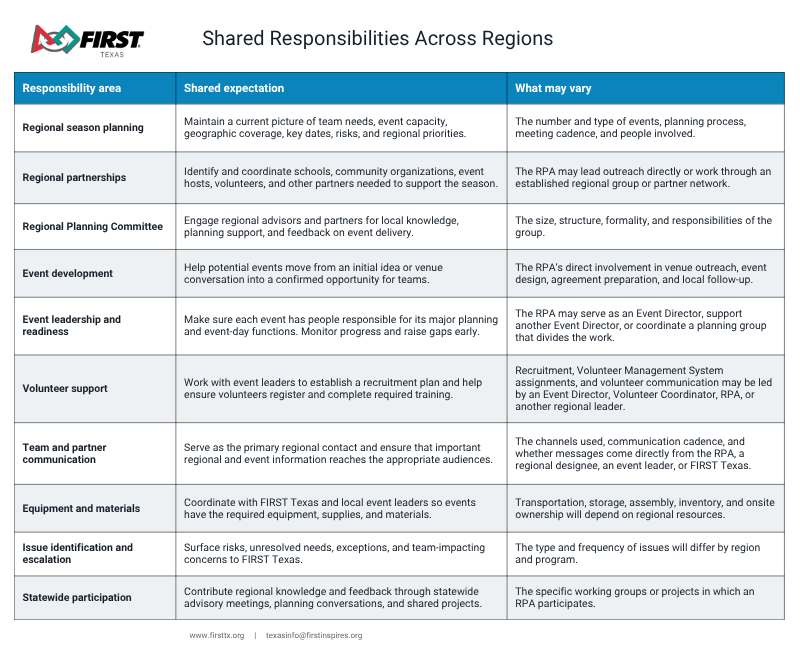
How Regional Flexibility Works
FIRST Texas does not expect every region to use the same local structure.
One region may have experienced Event Directors who lead most event planning. Another may rely on a regional planning group. An RPA may directly lead an event in one location while serving primarily as a coordinator for another.
Regional flexibility allows the work to reflect local capacity, relationships, and experience. It does not remove the need for clear ownership.
For each major area of work, the RPA should be able to answer:
What needs to happen?
Who is leading it?
What support do they need?
What is the next milestone?
Does FIRST Texas need to provide guidance, make a decision, or address a barrier?
The regional work plan provides a shared place for the RPA and FIRST Texas to document these answers. It is a living planning tool used to guide conversations and follow-through. A blank area in the work plan does not automatically become an RPA-owned task.
Working with Event Partners
FIRST Texas events depend on partnerships with schools, nonprofits, companies, coaches, and volunteers.
A hosting organization may provide only the facility, assist with selected planning responsibilities, identify an Event Director, or coordinate most of the local event. The event agreement does not automatically determine which of these arrangements applies.
The RPA should work with the host and available key volunteers to establish who will lead the major areas of event planning. The RPA remains involved by connecting the group, monitoring readiness, sharing resources, and raising gaps.
For more information:
How to Host an Event with FIRST Texas explains the general Venue Host and Event Director roles, venue needs, and support provided by FIRST Texas.
RPA Guide: How to Process Events explains how to move an event from an initial venue conversation through agreement processing, system entry, team assignment, and the beginning of detailed planning.
RPA Guide: How We Work Together explains how FIRST Texas Program, Staff, RPAs, Key Volunteers and Event Partners work together
COMING SOON: More information on how to divide event responsibilities and plan for events.
Working With FIRST Texas
The RPA does not work through these responsibilities alone. FIRST Texas provides statewide direction, systems, program resources, staff support, and decision-making.
Use RPA Guide: How We Work Together for:
FIRST Texas staff responsibilities
Questions and decisions to route to each staff member
Staff and RPA working relationships
Collaboration with regional groups and local event partners
Situations requiring statewide support or direction
RPAs should continue using regular calls, direct communication, and regional work-plan reviews to ask questions and address situations that do not fit neatly within a published guide.
What the RPA Does Not Automatically Own
Unless the RPA and FIRST Texas agree otherwise, the RPA does not automatically:
Serve as the Event Director for every regional event.
Personally complete every event-planning task.
Act as the Volunteer Coordinator for every event.
Sign agreements or make financial or contractual commitments for FIRST Texas.
Independently approve exceptions involving eligibility, advancement, fees, participation requirements, or other team-impacting decisions.
Take over every responsibility that a host or volunteer cannot complete.
When an important responsibility does not have an owner, the RPA should help identify an appropriate solution and alert FIRST Texas when additional support is needed.
Using the RPA Guide Series
The RPA and Event Partner Guide series will provide more detailed guidance for specific parts of regional program delivery.
Available now
How We Work Together: Staff roles, decision routing, working relationships, and collaboration with event partners
How to Process Events: Venue conversations, event agreements, program systems, team assignments, and the transition into planning
How to Host an Event: General information for prospective hosts about roles, venue needs, support, and stipends
How to Add an Event to the FIRST Texas Calendar: Public event-submission requirements
FLL Challenge Game Set Building and Storage: Preparation and storage of FLL Challenge materials
Guides in development
Future guidance may include:
Event-planning responsibilities and role assignment
FLL and FTC event-planning checklists
Venue layouts, room needs, and event flow
Event-planning timelines and readiness reviews
Volunteer recruitment and coordination
Regional communication planning
Team assignments, capacity, and waitlists
Advancement allocation and calculations
Equipment planning, transportation, and storage
Regional championships
Event closeout and season review
Until a detailed guide is available, RPAs should use their regional work plan and regular conversations with FIRST Texas to establish expectations, ownership, and next steps.