
RPA Guide - How to Process Events: From Starting Converstaions with Venues to Assigning Teams and Starting Planning
Introduction
Regional Program Administrators play a central role in moving an event from an initial venue conversation to a confirmed opportunity for teams. The RPA serves as the primary regional point of coordination, gathers the information needed to move the event forward, and works with FIRST Texas staff and local partners throughout the process.
This guide explains how to:
Evaluate a potential venue and begin the hosting conversation
Move an event into the agreement process
Add the event to the required program systems
Assign teams using the appropriate regional process
Transition from event confirmation into detailed planning
Communicate changes after an event has been submitted
The steps are presented in a general sequence, but some work may overlap. Event planning does not need to wait until agreements, system entry, or team assignments are complete. Once the date, venue, and basic event structure are reasonably stable, the RPA and local event team should begin working through the applicable event-planning guide.
Table of Contents
Event Processing at a Glance
Review the overall process and how responsibilities move between the RPA, FIRST Texas staff, and local event partners.Systems Used
Understand the systems and tracking tools used to process and publish events.Step 1: Identify a Venue and Begin the Conversation
Begin the venue conversation
Explain the support available
Review host stipends and event agreements
Address requests that differ from the standard process
Determine when the venue is ready to move forward
Step 2: Submit the Event for Agreement Processing
Provide the event information FIRST Texas needs to prepare and send the appropriate agreement.Step 3: Add the Event to the Required Systems
FIRST Tech Challenge process
FIRST LEGO League process
Step 4: Assign Teams to Events
FIRST Tech Challenge team assignments
FIRST LEGO League team assignments
Step 5: Continue Event Planning
Establish local responsibilities and begin working through the program-specific planning checklist.When Event Information Changes
Update the appropriate staff, systems, communications, and regional tracking records.FLL Challenge Game Set Building and Storage
Review expectations for coordinating the assembly, use, and storage of event game materials.
Event Processing at a Glance
Regional Program Administrators play a central role in moving local events from an initial venue conversation to a confirmed event that teams can attend. The RPA coordinates with the venue or host, gathers the information FIRST Texas needs, and helps ensure each event moves through the appropriate systems.
The RPA remains the primary regional point of coordination throughout this process, but some steps are completed by FIRST Texas staff.
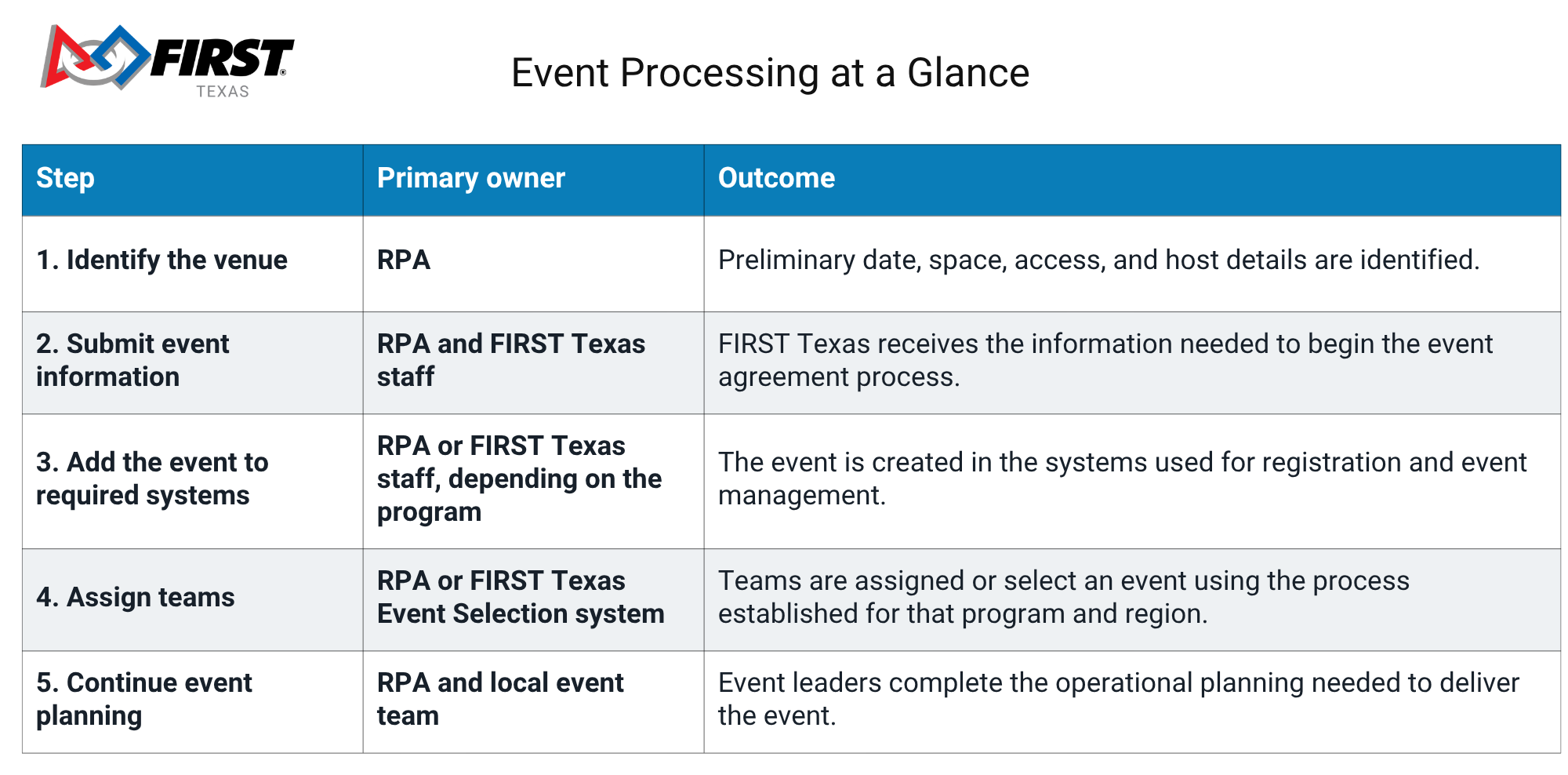
Event processing follows these general steps, but event planning does not need to wait until team assignments are complete. Once the date, venue, and basic event structure are stable, the RPA and local event team should begin working through the event-planning checklist.
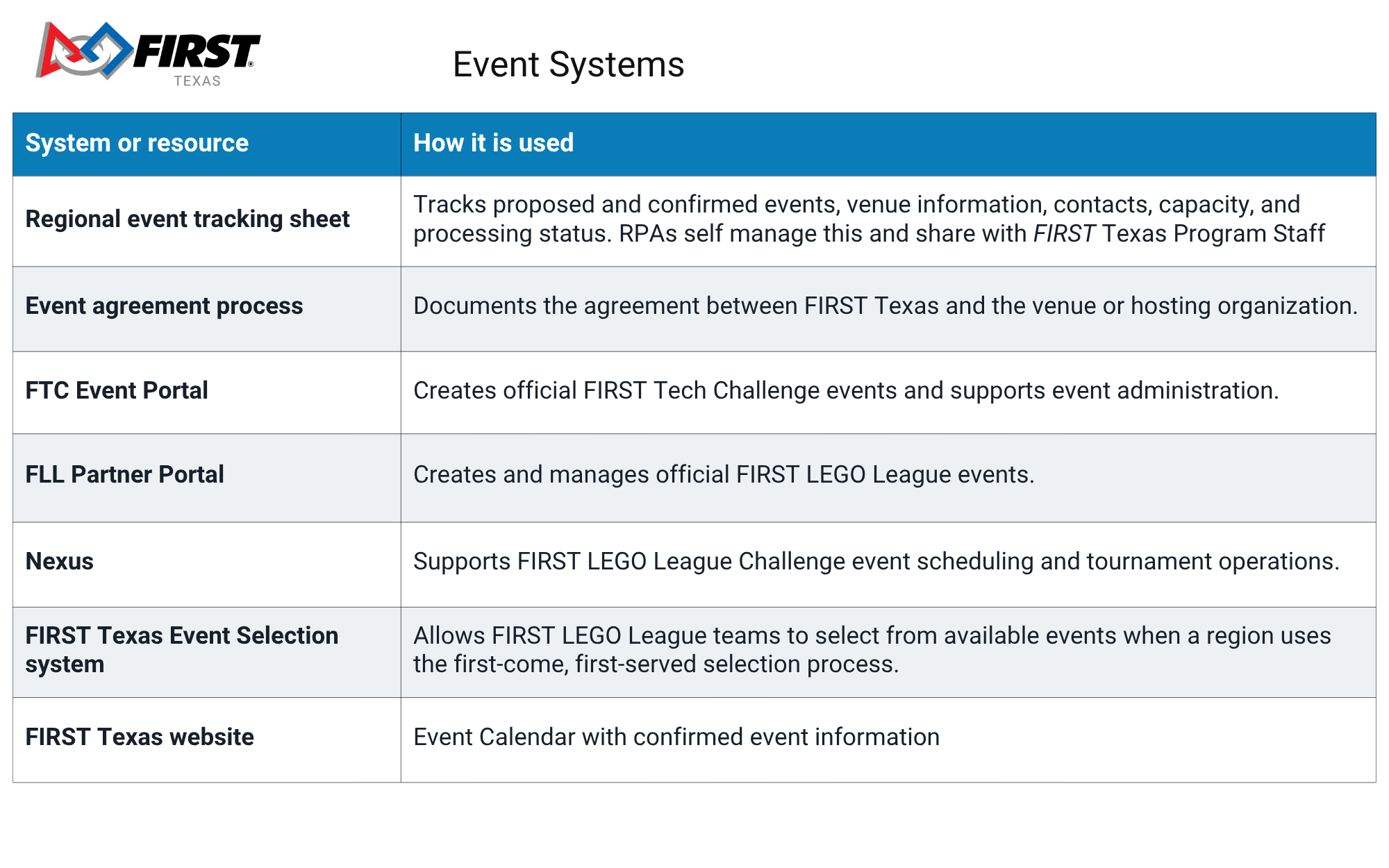
Systems Used
Step 1: Identify a Venue and Begin the Conversation
Begin the Venue Conversation
The RPA leads the initial conversation with a potential venue or hosting organization. The goal is to determine whether the location appears to be a good fit, understand how the organization may want to participate, and gather the information FIRST Texas needs to move forward.
A hosting organization may:
Provide the venue only
Provide the venue and assist with selected event tasks
Provide the venue and identify someone to lead local event coordination
The RPA should not assume that providing a venue means the organization will also serve as the Event Director. The specific division of event-planning responsibilities can be established later with the host, local event leaders, key volunteers, and FIRST Texas.
RPAs may navigate these conversations in the way that works best for their region and local relationships. The How to Host an Event page may be shared as a general introduction to the Venue Host and Event Director roles, FIRST Texas support, venue requirements, stipends, and the process for becoming an Event Partner.
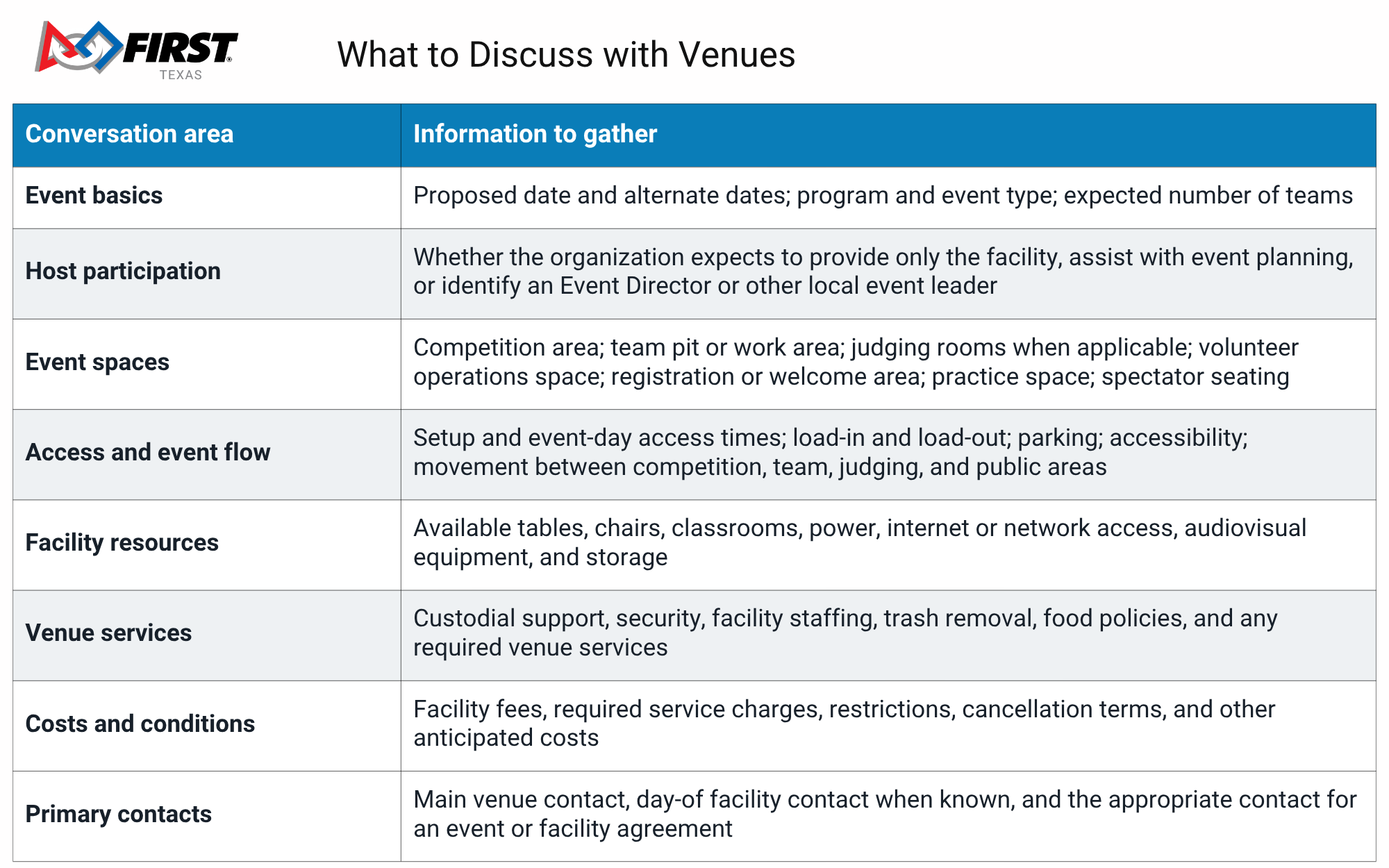
The above graphic shows conversation points for venues. We dont recommend approaching venues with all of this information up front. Some may be discussed through the process of arranging the event.
The FTC and FLL event-planning guides (COMING SOON) should be used to help determine whether the available spaces and resources are appropriate for the proposed program, event type, and team count. The initial conversation does not need to produce a complete layout or finalized operating plan.
Explain the Support Available
Prospective hosts should understand that they are not expected to provide every part of the event independently. FIRST Texas provides or coordinates program guidance, tournament systems, training, event equipment and supplies, team registration, volunteer-role training, and other event-delivery support. The local division of responsibilities will be confirmed as planning develops.
Host Stipends and Event Agreements
FIRST Texas provides a standard host stipend based on the program and event type. Current stipend amounts and general hosting information are maintained on the How to Host an Event page.
Once FIRST Texas confirms that an event is ready to move forward, the host will generally receive the standard event agreement. This agreement documents the event, the standard stipend, and the basic responsibilities of FIRST Texas and the hosting organization.
The RPA may work with the prospective host to:
Explain anticipated event and facility needs
Review the standard hosting and stipend process
Confirm the event date, location, primary contact, and expected capacity
Discuss what the venue or hosting organization may be able to provide
Gather the information FIRST Texas needs to prepare the agreement
The RPA should not sign an agreement or make contractual or financial commitments on behalf of FIRST Texas. Formal agreements, insurance requirements, purchasing, vendor onboarding, and other contractual terms are handled by FIRST Texas staff.
When a Host Needs to Deviate from the Standard Process
Some schools, districts, or other organizations may be unable to use the standard host agreement or stipend structure. For example, a district may require FIRST Texas to rent the facility under its standard terms, charge required service fees, or request changes to the standard agreement.
When this occurs, the RPA may:
Request the venue’s standard facility rates or a preliminary estimate
Gather information about required services, fees, deposits, or minimum charges
Ask for a copy of any required facility agreement or requested contract changes
Clarify which requirements are mandatory and which may be negotiable
Document the host’s requested arrangement and share it with Emily
The RPA should loop in Emily before:
Agreeing to a direct facility rental
Accepting costs beyond the standard host stipend
Agreeing to deposits, cancellation fees, minimum charges, or required services
Indicating that requested changes to the standard agreement will be accepted
Accepting any other nonstandard financial or contractual arrangement
Additional budget flexibility may be available when a school or district requires FIRST Texas to rent the facility under its established terms. However, FIRST Texas staff must review the proposed costs and conditions before any commitment is made.
The RPA should gather the necessary information without negotiating or approving terms on behalf of FIRST Texas. Staff will determine whether the requested arrangement can be accepted and will coordinate any revised agreement or additional documentation.
When the Venue Is Ready to Move Forward
The venue can be submitted for agreement processing in step 2 when the following are reasonably clear:
Proposed date and location
Program, event type, and approximate team capacity
Expected role of the hosting organization
Primary venue and agreement contacts
Expected costs
Major access requirements, restrictions, or conditions
Detailed layouts, equipment assignments, volunteer responsibilities, and event-day logistics may continue to develop after the venue moves into agreement processing.
Step 2: Submit the Event for Agreement Processing
Once the venue and initial event details are confirmed and the event is ready to move on to the agreement process, the RPA should send Erika Diggs an Excel spreadsheet containing the information needed to begin event processing.
Some RPAs may already be maintaining spreadsheets. We ask that they include the following information in their sheets to help make processing easier. If you do not have a spreadsheet yet please click the button below to access a template file that you can copy.
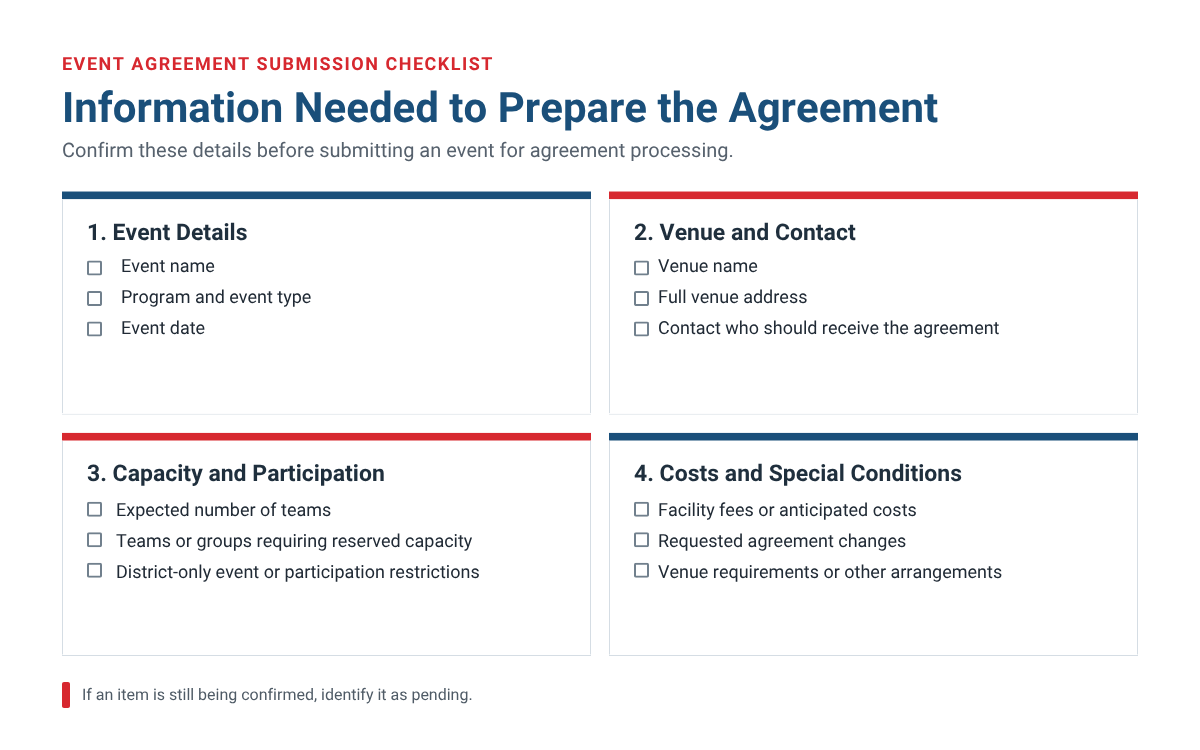
For Expected number of teams this does not have to be an exact number. What we want recorded is the upper limit for the event. So if an event cannot hold more than 24 teams the number should be 24. If an event can hold 30 teams but might actually be 24 teams in size provide the range 24-30 teams. The goal here is to make sure the agreement records the number of teams we should not exceed.
Erika will coordinate the next steps with the appropriate FIRST staff to get the event agreement out.
Step 3: Add the Event to the Required Systems
After FIRST Texas confirms that the event is ready to move forward, it must be entered into the systems used for that program.
FIRST Tech Challenge
FTC RPAs should prepare their regional events for bulk upload into the FTC Event Portal: https://event-portal.firstinspires.org/
Before submitting the upload:
Confirm the event information is accurate.
Compile the events into the required Excel format.
Send the file to Patrick Michaud for review.
Wait for confirmation before uploading the events.
The FTC RPA will complete the upload after Patrick confirms that the events are ready to be entered.
FIRST Texas staff will also coordinate publication of confirmed events on the FIRST Texas website.
FIRST LEGO League
FLL events must be created in Partner Portal and FLL Nexus. Once the RPA has submitted the information required in Step 2, Erika will coordinate adding the events to the appropriate systems.
FIRST Texas staff will also coordinate publication of confirmed events on the FIRST Texas website.
Step 4: Assign Teams to Events
The team-assignment process depends on the program.
FIRST Tech Challenge
FTC RPAs manage team assignments within their regions. Each RPA should establish a clear process for:
Communicating available events
Collecting team preferences or registrations
Monitoring event capacity
Maintaining any reserved capacity
Confirming assignments with teams
Managing waitlists or approved changes
FIRST LEGO League
FLL regions may use the FIRST Texas Event Selection system. This system allows teams to select an available event on a first-come, first-served basis. MORE DETAILS COMING SOON.
If a region will not use the Event Selection system, the RPA and FIRST Texas staff should agree on the team-assignment process before registration opens.
RPAs should confirm how reserved capacity, district-only participation, waitlists, and special circumstances will be handled before events become available to teams.
Step 5: Continue Event Planning
Administrative processing makes the event official and prepares it for team participation. It does not replace local event planning.
The RPA should work with the venue host, Event Director, Volunteer Coordinator, key volunteers, and other local partners to confirm ownership of major event deliverables. The exact structure may vary. One person may serve in multiple roles, or responsibilities may be divided across a planning group.
Planning should include:
Venue layout and room assignments
Event schedule
Equipment and materials
Volunteer leadership and recruitment
Judging and competition areas
Team communications
Food and volunteer hospitality
Safety and emergency procedures
Setup, teardown, and facility access
Event-day leadership and escalation contacts
Use the applicable event-planning guide and checklist to determine what must be completed, who owns each task, and when it is due.
MORE RESOURCES TO BE LINKED
When Event Information Changes
If the date, venue, capacity, participation requirements, or primary contact changes after submission, the RPA should notify Erika and the appropriate program staff promptly. Changes may need to be reflected in the event agreement, program systems, team communications, and the FIRST Texas website.
The regional tracking sheet should also be updated so that it remains the current record of the event’s status.